Marketing ROI: The Complete Guide to Measurement & Optimization (2026)
Everything you need to measure, track, and improve marketing ROI. Includes ROAS vs ROI, attribution models, channel benchmarks, and proven optimization strategies.
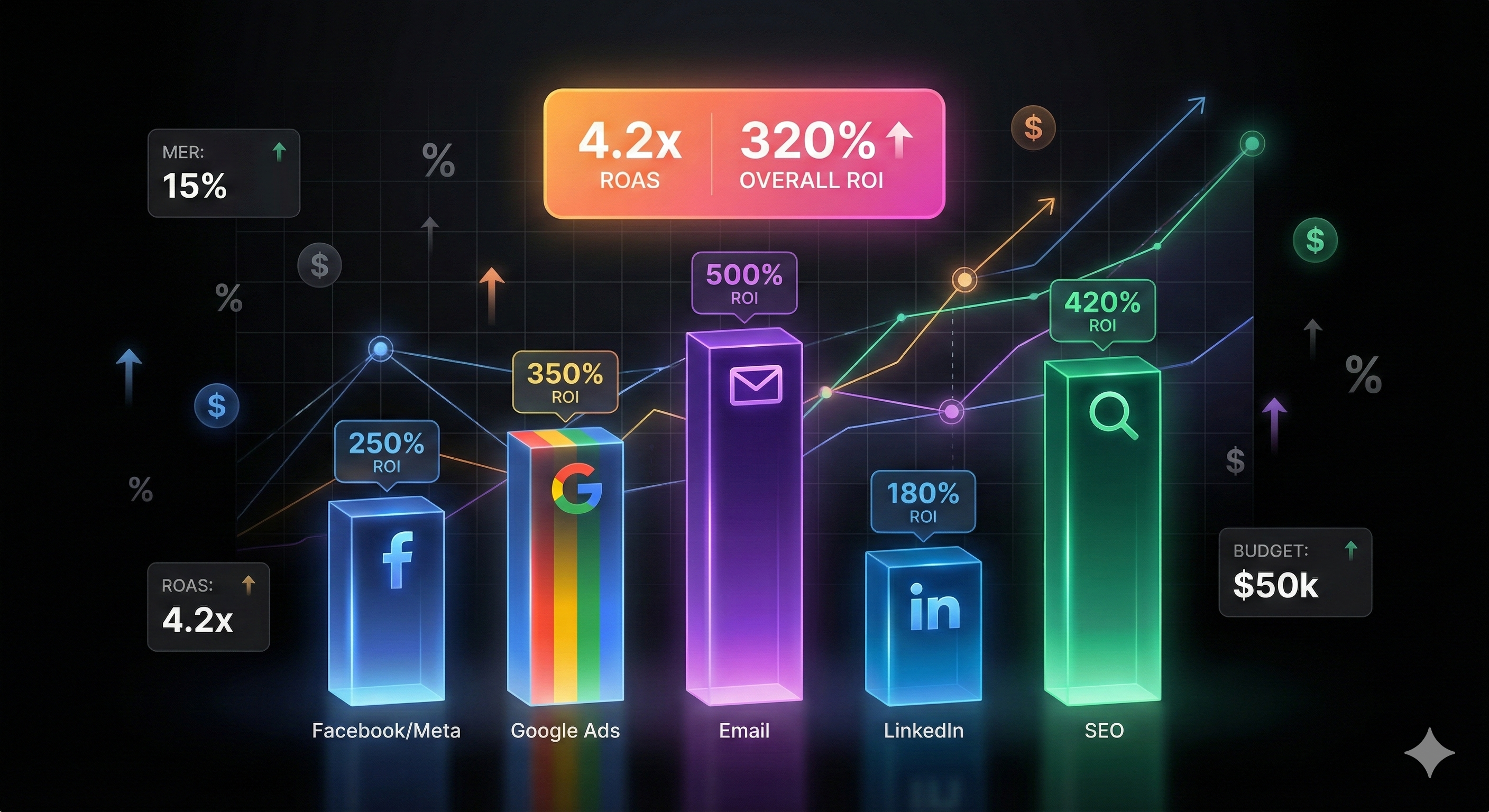
Marketing ROI: The Complete Guide to Measurement & Optimization (2026)
Marketing ROI is the single most important metric for justifying your marketing budget, optimizing channel mix, and proving that marketing is a growth driver—not a cost center.
Yet most businesses calculate it wrong, measure it inconsistently, or ignore it entirely.
This comprehensive guide covers everything you need to measure, track, and improve marketing ROI across all channels and business types.
Calculate Your Marketing ROI Now →
What is Marketing ROI?
Marketing ROI (Return on Investment) measures the revenue or profit generated from marketing activities relative to the cost of those activities.
The Core Concept
You spend $10,000 on marketing.
It generates $50,000 in revenue.
ROI = ($50,000 - $10,000) / $10,000 × 100 = 400% ROI
Or expressed as a ratio: 5:1 return (for every $1 spent, you get $5 back)
Why Marketing ROI is Crucial
For Budget Justification:
- Prove marketing's business impact
- Secure more budget from leadership
- Demonstrate accountability
- Move from cost center to profit driver
For Optimization:
- Identify which channels work
- Kill underperforming campaigns
- Double down on winners
- Optimize budget allocation
For Growth:
- Know how much to spend
- Scale profitable channels
- Forecast revenue impact
- Plan sustainable growth
For Company Health:
- Ensure profitable customer acquisition
- Avoid wasting resources
- Improve cash flow
- Maximize company valuation
The Marketing ROI Formula
The Standard Formula
Marketing ROI = (Revenue - Marketing Cost) / Marketing Cost × 100
Or:
Marketing ROI = (Revenue / Marketing Cost) - 1 × 100
Example:
- Marketing spend: $20,000
- Revenue generated: $100,000
- ROI = ($100,000 - $20,000) / $20,000 × 100 = 400%
The Better Formula: Using Gross Profit
Most businesses should use gross profit, not revenue:
Marketing ROI = (Gross Profit - Marketing Cost) / Marketing Cost × 100
Why Gross Profit is Better:
- Accounts for cost of goods sold (COGS)
- Shows true profitability
- More accurate for decision-making
- Prevents overspending on high-revenue, low-margin products
Example:
- Marketing spend: $20,000
- Revenue generated: $100,000
- COGS: $60,000
- Gross profit: $40,000
- ROI = ($40,000 - $20,000) / $20,000 × 100 = 100%
Big difference: 400% revenue ROI vs. 100% profit ROI!
Step-by-Step Calculation
Step 1: Define Time Period
- Monthly: Fast-moving businesses, quick feedback
- Quarterly: Standard for most businesses
- Annually: Long sales cycles, B2B
Step 2: Sum All Marketing Costs
Include:
- Paid advertising (all channels)
- Marketing salaries and benefits
- Agency and contractor fees
- Marketing tools and software
- Content production costs
- Events and sponsorships
- Creative and design costs
- Marketing portion of office/overhead
Don't Include:
- Product development
- General overhead not allocated to marketing
- Sales costs (unless combined sales + marketing ROI)
Step 3: Measure Revenue/Profit
Track Revenue Attributed to Marketing:
- Use attribution software (first-touch, last-touch, multi-touch)
- Track campaign source in CRM
- Use UTM parameters consistently
- Connect ecommerce platform to attribution
Calculate Gross Profit:
- Revenue from marketing
- Minus cost of goods sold (COGS)
- Equals gross profit
Step 4: Calculate ROI
ROI = (Gross Profit - Marketing Cost) / Marketing Cost × 100
Real Example: DTC Ecommerce Brand
February 2026 Marketing Costs:
- Facebook ads: $30,000
- Google ads: $25,000
- Influencer marketing: $10,000
- Email marketing tool: $500
- Marketing manager salary: $8,000
- Content creation: $5,000
- Total: $78,500
February 2026 Revenue:
- Revenue attributed to marketing: $350,000
- COGS (40% of revenue): $140,000
- Gross profit: $210,000
Marketing ROI:
ROI = ($210,000 - $78,500) / $78,500 × 100
ROI = $131,500 / $78,500 × 100
ROI = 167.5%
Or expressed as ratio: 2.7:1 (for every $1 spent, earned $2.70 in gross profit)
ROAS vs. ROI: Key Differences
ROAS (Return on Ad Spend)
Formula:
ROAS = Revenue / Ad Spend
Example:
- Ad spend: $10,000
- Revenue: $50,000
- ROAS = 5x (or 500%)
What It Measures: Revenue efficiency of advertising
Use Cases:
- Measuring ad platform performance
- Comparing ad campaigns
- Optimizing bids and budgets
- Quick campaign assessment
Limitations:
- Ignores profit margins
- Doesn't include other marketing costs
- Can be misleading for low-margin products
ROI (Return on Investment)
Formula:
ROI = (Gross Profit - Marketing Cost) / Marketing Cost × 100
Example:
- Marketing spend: $10,000
- Revenue: $50,000
- Gross margin: 60%
- Gross profit: $30,000
- ROI = 200% (or 3x)
What It Measures: Profitability of entire marketing investment
Use Cases:
- Overall marketing effectiveness
- Budget planning
- Business decisions
- Comparing to other investments
Advantages:
- Accounts for profitability
- Includes all marketing costs
- True business impact
- Better for decision-making
When to Use Each
Use ROAS When:
- Optimizing paid ad campaigns
- Comparing ad platforms
- Real-time campaign management
- Working with ad buyers
Use ROI When:
- Reporting to executives
- Making budget decisions
- Evaluating overall marketing
- Planning growth strategy
Use Both:
- ROAS for tactical optimization
- ROI for strategic decisions
Example: Why Both Matter
Scenario: Two products
Product A:
- Ad spend: $10,000
- Revenue: $50,000
- ROAS: 5x (looks great!)
- Gross margin: 20%
- Gross profit: $10,000
- ROI: 0% (break-even!)
Product B:
- Ad spend: $10,000
- Revenue: $30,000
- ROAS: 3x (looks worse)
- Gross margin: 70%
- Gross profit: $21,000
- ROI: 110% (much better!)
Lesson: High ROAS doesn't always mean high ROI. Gross margin matters!
What Costs to Include in Marketing ROI
The Three Levels
Level 1: Direct Ad Spend Only (ROAS approach)
- Facebook ads
- Google ads
- TikTok ads
- Other paid media
Pros: Simple, easy to calculate Cons: Significantly overstates ROI
Level 2: All Marketing Expenses (Standard ROI)
- All paid advertising
- Marketing team salaries
- Marketing tools and software
- Agency and contractor fees
- Content production
- Events and sponsorships
Pros: Accurate, complete picture Cons: More complex to calculate Recommended: Use this for true ROI
Level 3: Fully Loaded Marketing Costs (Conservative ROI)
- Everything from Level 2
- Allocated overhead (office space, etc.)
- Executive time on marketing
- Cross-functional support (design, analytics, etc.)
Pros: Most conservative, includes everything Cons: Can be overly conservative Use: For enterprise businesses with high overhead
Common Cost Categories
Paid Advertising:
- Ad platform spend (Facebook, Google, TikTok, LinkedIn, etc.)
- Display and programmatic
- Affiliate fees
- Sponsored content
- Podcast/influencer sponsorships
Marketing Team:
- Full-time salaries and benefits
- Contractors and freelancers
- Agency fees (media buying, creative, SEO, etc.)
Marketing Technology:
- Email marketing (Mailchimp, Klaviyo)
- CRM (HubSpot, Salesforce)
- Analytics (Google Analytics, Amplitude)
- Social media management
- Marketing automation
- Landing page builders
Content Production:
- Video production
- Photography
- Copywriting
- Graphic design
- Website development
Events and Experiences:
- Trade shows
- Conferences
- Branded events
- Sponsorships
Other:
- Market research
- PR and communications
- Promotions and discounts (debatable, often excluded)
What NOT to Include
Product Costs:
- Cost of goods sold (COGS)
- Product development
- Fulfillment and shipping (unless part of acquisition offer)
General Business Costs:
- Accounting and finance
- Legal
- General office overhead (unless allocating)
Sales Costs (Unless Calculating Sales + Marketing ROI):
- Sales team salaries
- Sales tools
- Sales operations
Multi-Channel ROI Tracking
Modern customers interact with multiple channels before purchasing. Tracking ROI by channel is essential but complex.
The Attribution Challenge
Customer Journey Example:
- Sees Facebook ad (first touch)
- Clicks, visits website
- Leaves without buying
- Receives email nurture
- Clicks email, browses
- Searches brand on Google
- Clicks Google ad (last touch)
- Purchases
Question: Which channel gets credit for the sale?
Answer: Depends on your attribution model.
Attribution Models Overview
First-Touch Attribution:
- Credits the first interaction (Facebook ad)
- Pros: Shows top-of-funnel effectiveness
- Cons: Ignores nurture and conversion channels
Last-Touch Attribution:
- Credits the last interaction (Google ad)
- Pros: Shows what drives final conversion
- Cons: Ignores awareness and consideration
Linear Attribution:
- Credits all touchpoints equally
- Pros: Fair, gives credit to entire journey
- Cons: Treats all touchpoints as equally important (not realistic)
Time-Decay Attribution:
- More credit to recent interactions
- Pros: Weights conversion channels more
- Cons: Still somewhat arbitrary
Position-Based (U-Shaped):
- 40% credit to first touch, 40% to last touch, 20% distributed to middle
- Pros: Recognizes importance of awareness and conversion
- Cons: Middle touches may be undervalued
Data-Driven Attribution:
- Uses machine learning to assign credit based on actual impact
- Pros: Most accurate
- Cons: Requires significant data, sophisticated tools
Recommended Approach
For Most Businesses:
- Use last-touch for paid ads (easy, standard)
- Use first-touch for brand awareness campaigns
- Use data-driven if you have the tools (Google Analytics 4, HubSpot, etc.)
For Sophisticated Businesses:
- Implement multi-touch attribution platform (Segment, Rockerbox, Attribution)
- Track full customer journey
- Use incrementality testing to validate
Channel-Specific ROI Calculation
Calculate ROI for Each Channel Separately:
Example:
| Channel | Spend | Revenue | Gross Profit | ROI |
|---|---|---|---|---|
| Google Ads | $30,000 | $180,000 | $108,000 | 260% |
| Facebook Ads | $40,000 | $160,000 | $96,000 | 140% |
| Email Marketing | $5,000 | $80,000 | $48,000 | 860% |
| Content/SEO | $15,000 | $100,000 | $60,000 | 300% |
| Total | $90,000 | $520,000 | $312,000 | 247% |
Insights:
- Email has highest ROI (but limited scale)
- Google Ads has best ROI of paid channels
- Facebook Ads has lowest ROI (opportunity to optimize or cut)
- Content/SEO has strong ROI with long-term compounding
Actions:
- Increase Google Ads budget
- Optimize or reduce Facebook Ads spend
- Invest more in email list growth
- Continue SEO investment for compounding returns
Time Period Considerations
Short-Term vs. Long-Term ROI
Short-Term ROI (1-3 months):
- Measures immediate impact
- Good for paid advertising
- Useful for quick optimization
- Can miss delayed conversions
Long-Term ROI (6-12+ months):
- Captures full customer lifetime value
- Essential for content, SEO, brand building
- More accurate for long sales cycles
- Harder to calculate
Time Lag in Marketing
Not all marketing generates immediate results.
Example Time Lags:
- Paid search: 0-7 days
- Paid social: 1-30 days
- Content marketing: 3-12 months
- SEO: 6-18 months
- Brand campaigns: 3-24 months
- Influencer: 1-90 days
Matching Costs and Revenue
Problem: Spending in January, revenue comes in March
Solutions:
Approach 1: Lag Revenue
- Track when spend occurred
- Attribute revenue when it happens
- Use average lag (e.g., 30 days)
Approach 2: Cohort Analysis
- Group customers by acquisition month
- Track their revenue over time
- Calculate ROI once cohort matures
Approach 3: Customer Lifetime Value
- Don't just track first purchase
- Include repeat purchases
- Calculate true LTV-based ROI
Calculate your LTV: Customer LTV Calculator →
Marketing ROI Benchmarks by Channel
These benchmarks are averages across industries. Your results will vary based on business model, margins, competition, and execution quality.
Paid Search (Google Ads)
ROI Benchmarks:
- Excellent: 400%+ (5:1 ratio)
- Good: 300-400% (4:1 to 5:1)
- Average: 200-300% (3:1 to 4:1)
- Below Average: 100-200% (2:1 to 3:1)
- Poor: <100% (less than 2:1)
ROAS Benchmarks (for reference):
- Excellent: 8:1+
- Good: 5:1 to 8:1
- Average: 4:1 to 5:1
- Below Average: 2:1 to 4:1
Why Generally Strong: High intent, bottom-of-funnel
Paid Social (Facebook, Instagram, TikTok)
ROI Benchmarks:
- Excellent: 300%+ (4:1 ratio)
- Good: 200-300% (3:1 to 4:1)
- Average: 150-200% (2.5:1 to 3:1)
- Below Average: 100-150% (2:1 to 2.5:1)
- Poor: <100%
ROAS Benchmarks:
- Excellent: 6:1+
- Good: 4:1 to 6:1
- Average: 3:1 to 4:1
- Below Average: 2:1 to 3:1
Why Variable: Broad targeting, interruption-based, heavily dependent on creative quality
Email Marketing
ROI Benchmarks:
- Excellent: 1000%+ (10:1+ ratio)
- Good: 500-1000% (6:1 to 10:1)
- Average: 300-500% (4:1 to 6:1)
- Below Average: 200-300% (3:1 to 4:1)
Why So High: Low cost, owned audience, high intent from existing customers/subscribers
Content Marketing & SEO
ROI Benchmarks (12-month view):
- Excellent: 500%+ (6:1 ratio)
- Good: 300-500% (4:1 to 6:1)
- Average: 200-300% (3:1 to 4:1)
- Below Average: 100-200% (2:1 to 3:1)
Note: ROI compounds over time. Year 1 might be 100%, Year 3 might be 1000%+.
Why Compounds: Content keeps driving traffic without ongoing costs
Display Advertising
ROI Benchmarks:
- Excellent: 300%+ (4:1 ratio)
- Good: 200-300% (3:1 to 4:1)
- Average: 150-200% (2.5:1 to 3:1)
- Below Average: 100-150% (2:1 to 2.5:1)
- Poor: <100%
Why Lower: Top-of-funnel, awareness focused, lower intent
Video Advertising (YouTube, OTT)
ROI Benchmarks:
- Excellent: 400%+ (5:1 ratio)
- Good: 250-400% (3.5:1 to 5:1)
- Average: 150-250% (2.5:1 to 3.5:1)
- Below Average: 100-150% (2:1 to 2.5:1)
Why Improving: Better targeting, attribution improving, high engagement
Influencer Marketing
ROI Benchmarks:
- Excellent: 500%+ (6:1 ratio)
- Good: 300-500% (4:1 to 6:1)
- Average: 200-300% (3:1 to 4:1)
- Below Average: 100-200% (2:1 to 3:1)
- Poor: <100%
Why Variable: Highly dependent on influencer fit, audience quality, and authenticity
Affiliate Marketing
ROI Benchmarks:
- Excellent: 400%+ (5:1 ratio)
- Good: 300-400% (4:1 to 5:1)
- Average: 200-300% (3:1 to 4:1)
- Below Average: 100-200% (2:1 to 3:1)
Why Often Strong: Performance-based, low upfront risk
Industry-Specific Marketing ROI Benchmarks
Ecommerce
Average Marketing ROI: 200-300% (3:1 to 4:1 gross profit ratio)
Channel Performance:
- Email: 800-1200%
- Paid search: 300-400%
- Paid social: 200-300%
- SEO/Content: 400-600% (long-term)
Success Factors:
- Product margins (higher margins = better ROI)
- Repeat purchase rate
- Customer lifetime value
- Competitive intensity
SaaS (B2B)
Average Marketing ROI: 250-400% (3.5:1 to 5:1 gross profit ratio)
Channel Performance:
- Content/SEO: 500-1000%
- Paid search: 300-500%
- Email: 600-1000%
- Paid social: 150-250%
Success Factors:
- Long sales cycles require patience
- High LTV justifies higher CAC
- Retention is critical
- Focus on MQL and SQL quality
SaaS (B2C)
Average Marketing ROI: 200-300% (3:1 to 4:1 gross profit ratio)
Channel Performance:
- Paid search: 250-400%
- Paid social: 200-350%
- Email: 700-1000%
- SEO/Content: 300-600%
Success Factors:
- Lower price points
- Higher volume
- Faster sales cycles
- Churn management crucial
B2B Services
Average Marketing ROI: 300-500% (4:1 to 6:1 gross profit ratio)
Channel Performance:
- LinkedIn ads: 200-300%
- Content/SEO: 400-800%
- Email: 500-900%
- Events: 200-400%
Success Factors:
- Relationship-driven
- Longer sales cycles (track to closed deals, not leads)
- High margins offset slower velocity
Retail (Physical)
Average Marketing ROI: 150-250% (2.5:1 to 3.5:1 gross profit ratio)
Channel Performance:
- Local search: 300-500%
- Facebook/Instagram: 200-300%
- Email/SMS: 600-1000%
- Direct mail: 150-250%
Success Factors:
- Local targeting
- Foot traffic measurement challenges
- Omnichannel attribution
Real Estate
Average Marketing ROI: 400-800% (5:1 to 9:1 gross profit ratio)
Channel Performance:
- Google Ads: 400-600%
- Facebook Ads: 300-500%
- SEO: 600-1200%
- Zillow/Realtor leads: 200-400%
Success Factors:
- High transaction values
- Long sales cycles
- Lead quality over quantity
- Relationship and referral-driven
Education (Online Courses, Coaching)
Average Marketing ROI: 200-400% (3:1 to 5:1 gross profit ratio)
Channel Performance:
- Webinar funnels: 300-600%
- Facebook Ads: 200-350%
- YouTube: 250-450%
- Email: 800-1500%
Success Factors:
- High perceived value
- Low COGS (digital products)
- Strong creator brand
- Community and retention
Marketing Efficiency Ratio (MER)
MER is an alternative way to measure marketing effectiveness, popularized by ecommerce brands.
What is MER?
MER = Total Revenue / Total Marketing Spend
MER vs. ROI
MER:
- Simpler (just revenue / spend)
- Doesn't account for profitability
- Good for quick benchmarking
- Used heavily in ecommerce
ROI:
- Accounts for margins
- More accurate for decision-making
- Standard business metric
- Better for strategic planning
MER Benchmarks
Ecommerce MER Targets:
- World-class: 5:1+
- Excellent: 4:1 to 5:1
- Good: 3:1 to 4:1
- Needs improvement: 2:1 to 3:1
- Concerning: <2:1
When to Use MER
Use MER When:
- Quick daily/weekly tracking
- Ecommerce with consistent margins
- Benchmarking across periods
- Simple communication
Use ROI When:
- Product mix varies (different margins)
- Strategic planning
- Budget allocation decisions
- Reporting to executives/board
Blended vs. Channel-Specific ROI
Blended ROI
Definition: Overall marketing ROI across all channels combined
Formula:
Blended ROI = (Total Gross Profit - Total Marketing Cost) / Total Marketing Cost × 100
Pros:
- Simple, single number
- Good for executive reporting
- Shows overall effectiveness
- Easy to track over time
Cons:
- Hides channel-specific performance
- Can mask underperformers
- Doesn't guide optimization
Channel-Specific ROI
Definition: ROI calculated separately for each marketing channel
Pros:
- Shows what's working
- Guides budget allocation
- Identifies optimization opportunities
- Enables data-driven decisions
Cons:
- More complex
- Attribution challenges
- Channels interact (not fully independent)
The Right Approach
Track Both:
- Blended ROI for overall health and executive reporting
- Channel-specific ROI for optimization and budget allocation
Example:
- Blended ROI: 250% (good overall)
- Email ROI: 900% (amazing, but limited scale)
- Paid search ROI: 350% (strong, scalable)
- Paid social ROI: 120% (concerning, needs optimization or cut)
Action: Shift budget from paid social to paid search, invest in growing email list
How to Prove Marketing ROI to Executives
The Executive Challenge
Executives care about:
- Revenue growth: Is marketing driving it?
- Profitability: Are we spending efficiently?
- Predictability: Can we forecast results?
- Accountability: Can we trust the numbers?
The 5-Part Framework
1. Use Their Language
Don't Say: "Our Facebook ROAS is 4.2x"
Do Say: "For every dollar we spend on marketing, we generate $3.50 in gross profit (250% ROI)"
2. Show the Business Impact
Connect Marketing to Business Goals:
- Marketing generated 65% of new customers this quarter
- Marketing ROI of 250% means we can profitably scale
- Increasing marketing budget by $50k will add $175k in gross profit
3. Use Multiple Proof Points
Combine Metrics:
- ROI: Overall profitability
- CAC: Customer acquisition efficiency
- LTV:CAC: Long-term value creation
- Payback period: Cash flow impact
- Customer growth: Volume impact
4. Demonstrate Attribution
Show You Know Where Revenue Comes From:
- "We track every customer source using UTM parameters and CRM attribution"
- "Here's the full customer journey from first touch to purchase"
- "We run incrementality tests to validate our attribution"
5. Present Options and Tradeoffs
Give Scenarios:
- Option A: Maintain current budget, grow 15% (250% ROI)
- Option B: Increase budget 30%, grow 25% (220% ROI, still profitable)
- Option C: Cut budget 20%, grow 8% (280% ROI, but slower growth)
Let them choose the right balance of growth vs. efficiency.
The Perfect Marketing ROI Report
Monthly Executive Marketing Report Structure:
1. Executive Summary (3-5 bullets):
- Overall marketing ROI: 247%
- Generated $850k in revenue, $510k in gross profit, on $150k spend
- New customers: 450 (avg CAC $333)
- Best channel: Paid search (360% ROI)
- Recommendation: Increase paid search budget 25%
2. Top-Level Metrics:
- Revenue
- Gross profit
- Marketing spend
- ROI
- New customers
- CAC
- LTV:CAC ratio
3. Channel Breakdown (table):
| Channel | Spend | Revenue | Gross Profit | ROI | Customers | CAC |
|---|---|---|---|---|---|---|
| Paid Search | $50k | $350k | $210k | 320% | 180 | $278 |
| Paid Social | $60k | $280k | $168k | 180% | 200 | $300 |
| $10k | $120k | $72k | 620% | 50 | $200 | |
| SEO/Content | $30k | $100k | $60k | 100% | 20 | $1,500 |
| Total | $150k | $850k | $510k | 240% | 450 | $333 |
4. Key Insights:
- Paid search continues to be most efficient channel (320% ROI)
- Paid social ROI declined from 210% to 180% (iOS 14 impact)
- Email maintaining strong performance (620% ROI)
- SEO starting to show results (100% ROI, will compound)
5. Actions and Recommendations:
- Increase paid search budget by $15k/month
- Optimize or reduce paid social (test new creative, audiences)
- Continue SEO investment (6-12 month payoff period)
- Grow email list (highest ROI channel)
10 Strategies to Improve Marketing ROI
Strategy 1: Kill Underperforming Channels
Impact: Immediate ROI improvement by cutting waste
How:
- Calculate ROI by channel
- Identify channels with ROI < 100% (losing money)
- Kill or drastically reduce spend
- Reallocate to winning channels
Example:
- Channel A: $20k spend, 80% ROI (losing money)
- Channel B: $20k spend, 400% ROI (strong)
- Action: Cut A, double down on B
- Result: Overall ROI jumps from 240% to 400%
Expected Impact: 20-50% ROI improvement
Strategy 2: Improve Conversion Rates
Impact: More revenue from same traffic = better ROI
How:
- A/B test landing pages
- Optimize checkout flow
- Improve website speed (< 2 seconds)
- Add live chat
- Simplify forms
- Use social proof and urgency
Example:
- Current: 2% conversion rate, 250% ROI
- Improved: 3% conversion rate (50% increase), 375% ROI
Use our tool: Conversion Rate Calculator →
Expected Impact: 25-75% ROI improvement
Strategy 3: Increase Average Order Value
Impact: More revenue per customer = better ROI
How:
- Product bundles
- Upsells and cross-sells
- Free shipping thresholds
- Volume discounts
- Subscription options
- Add-ons at checkout
Example:
- Current: $75 AOV, 250% ROI
- Improved: $100 AOV (33% increase), 333% ROI
Expected Impact: 20-40% ROI improvement
Strategy 4: Improve Targeting
Impact: Less waste, more qualified traffic
How:
- Use lookalike audiences
- Exclude non-converting segments
- Target based on intent signals
- Use first-party data
- Implement better audience segmentation
- Test and refine continuously
Example:
- Current: Broad targeting, 10% waste
- Improved: Tight targeting, 5% waste
- Result: 5% better ROI
Expected Impact: 15-30% ROI improvement
Strategy 5: Optimize Creative
Impact: Better creative = higher CTR and conversion = better ROI
How:
- Test multiple ad creatives
- Use video (typically outperforms static)
- Focus on benefits, not features
- Strong call-to-action
- Social proof in ads
- Refresh creative every 2-4 weeks
Example:
- Current creative: 2% CTR
- New creative: 3.5% CTR
- Result: 75% more traffic, same spend, better ROI
Expected Impact: 30-60% ROI improvement
Strategy 6: Extend Customer Lifetime Value
Impact: Long-term, customers worth more = can afford higher CAC = better ROI
How:
- Improve retention (biggest lever)
- Create subscription/repeat purchase model
- Upsell and cross-sell existing customers
- Build loyalty programs
- Improve product quality
Example:
- Current LTV: $300
- Improved LTV: $450 (50% increase)
- Result: Can spend 50% more on acquisition at same ROI
Calculate your LTV: Customer LTV Calculator →
Expected Impact: 30-100%+ long-term ROI improvement
Strategy 7: Build Organic Channels
Impact: Organic traffic has infinite ROI once built
How:
- Invest in SEO and content marketing
- Build email list aggressively
- Create referral programs
- Develop social media organically
- Encourage user-generated content
Timeline: 6-18 months to see results
Example:
- Year 1: 80% paid, 20% organic, 250% blended ROI
- Year 3: 40% paid, 60% organic, 500% blended ROI
Expected Impact: 50-200% ROI improvement long-term
Strategy 8: Improve Attribution
Impact: Better tracking = better optimization = better ROI
How:
- Implement proper UTM tracking
- Use multi-touch attribution
- Connect all data sources
- Track full customer journey
- Run incrementality tests
Why It Matters: If you don't know what's working, you can't optimize
Expected Impact: 20-40% ROI improvement through better decision-making
Strategy 9: Test and Iterate Continuously
Impact: Constant improvement compounds
How:
- A/B test everything (ads, landing pages, emails)
- Test new channels quarterly
- Experiment with new tactics
- Kill what doesn't work fast
- Double down on winners
Culture: Make testing a habit, not a one-time project
Expected Impact: 5-10% ROI improvement per quarter (compounds!)
Strategy 10: Align Marketing and Product
Impact: Better product = better retention = better LTV = better marketing ROI
How:
- Marketing should inform product roadmap
- Product should make marketing easier (viral features, referral programs)
- Align on customer personas
- Use customer feedback from both teams
Example:
- Marketing finds product gap through customer research
- Product builds feature
- Retention improves 20%
- LTV increases 30%
- Marketing can spend more profitably
Expected Impact: 30-80% long-term ROI improvement
Common Marketing ROI Attribution Mistakes
Mistake #1: Only Tracking Last-Click
Problem: Giving all credit to the last touchpoint ignores the full journey
Reality: Most customers have 5-15 touchpoints before buying
Fix: Use multi-touch attribution
Impact: Undervalues awareness and consideration channels
Mistake #2: Not Accounting for Organic Uplift
Problem: Paid ads often drive branded search and organic traffic
Reality: Cut paid ads, and organic traffic often drops too
Fix: Run incrementality tests (geo-based holdouts)
Impact: Overstates paid ad efficiency, understates organic interdependence
Mistake #3: Ignoring Time Lag
Problem: Measuring February ads against February revenue
Reality: February ads may drive March and April revenue
Fix: Use cohort analysis or longer attribution windows
Impact: Understates ROI, especially for longer sales cycles
Mistake #4: Not Segmenting by Customer Type
Problem: Treating new customer acquisition and existing customer upsells equally
Fix: Separate new customer ROI from retention/expansion ROI
Impact: Hides true acquisition costs
Mistake #5: Using Revenue Instead of Gross Profit
Problem: High revenue doesn't always mean high profit
Fix: Always calculate ROI using gross profit
Impact: Overstates ROI, especially for low-margin products
Mistake #6: Forgetting Marketing Team Costs
Problem: Only counting ad spend, not salaries and tools
Fix: Include all marketing costs (see "What Costs to Include" section)
Impact: Significantly overstates ROI (often by 50-100%)
Mistake #7: Short-Term Optimization at Long-Term Cost
Problem: Optimizing for immediate ROAS kills brand building
Fix: Balance short-term performance marketing with long-term brand building
Impact: Improves ROI today, but limits future growth
Handling Negative ROI
When Negative ROI is Acceptable
Early-Stage Customer Acquisition:
- Building brand awareness
- Testing new channels
- Learning customer acquisition
- Creating social proof
Duration: 3-6 months max, then must improve
Long Sales Cycles:
- B2B with 6-12 month sales cycles
- High-ticket items ($10k+)
- Enterprise SaaS
Approach: Measure ROI at closed deal, not lead generation
Strategic Investments:
- SEO (negative early, positive long-term)
- Content marketing (6-18 month payback)
- Brand campaigns (long-term value)
Condition: Must have plan and timeline to profitability
When to Cut Negative ROI Channels
Red Flags:
- No improvement after 3 months of optimization
- Getting worse over time
- Fundamentally broken (low quality leads, high refund rates)
- Better alternatives available
Action:
- Pause spending immediately
- Analyze what went wrong
- Test fixes (if worth it)
- If no improvement in 30 days, kill completely
Troubleshooting Negative ROI
Step 1: Verify Tracking
- Is attribution set up correctly?
- Are all conversions being tracked?
- Check for technical issues
Step 2: Check Conversion Rate
- Is traffic quality good?
- Is landing page optimized?
- Is offer compelling?
Step 3: Analyze Profit Margins
- Are margins too low to support paid acquisition?
- Can you increase prices?
- Can you reduce COGS?
Step 4: Test and Optimize
- New creative
- Different targeting
- Better landing pages
- Adjusted offers
Step 5: Accept or Cut
- If profitable path exists, continue testing
- If fundamentally broken, cut and reallocate
Marketing ROI Dashboard Essentials
The 7 Metrics Every Dashboard Should Have
1. Overall Marketing ROI
- Current month
- Trend over time
- vs. target
2. Marketing Spend
- By channel
- vs. budget
- Trend over time
3. Revenue/Gross Profit Attributed to Marketing
- Current month
- Trend over time
- % of total revenue
4. Channel-Specific ROI
- Table with all channels
- Color-coded (green = above target, red = below)
- Trend arrows
5. New Customer Acquisition
- Total new customers
- By channel
- CAC by channel
6. Conversion Rates
- By channel
- By landing page
- Funnel drop-off points
7. LTV:CAC Ratio
- Overall
- By channel
- By customer segment
Dashboard Best Practices
Update Frequency:
- Daily: Ad spend, revenue, ROAS
- Weekly: Channel performance, key campaigns
- Monthly: Full ROI, executive reporting
Visualization:
- Use charts for trends
- Use tables for channel breakdown
- Color-code performance vs. targets
- Keep it simple (one page if possible)
Accessibility:
- Share with relevant stakeholders
- Automated email reports
- Real-time dashboard for marketing team
Conclusion
Marketing ROI is the ultimate measure of marketing effectiveness. Master it, and you'll always know whether your marketing is working, which channels to invest in, and how to grow profitably.
Key Takeaways:
- Use gross profit, not just revenue: Accounts for true profitability
- Track ROI by channel: Optimize what you measure
- Include all marketing costs: Salaries, tools, agencies, not just ad spend
- Benchmark against your industry: Know what "good" looks like
- Balance short-term and long-term: ROAS for tactics, ROI for strategy
- Implement proper attribution: Multi-touch when possible
- Kill underperformers: Ruthlessly cut negative ROI channels
- Double down on winners: Scale what works
- Test continuously: Small improvements compound
- Report to executives: Prove marketing's impact
Ready to calculate your marketing ROI?
Calculate Your Marketing ROI →
Measure your impact. Optimize your spend. Grow profitably.
Related Resources:
- ROI Calculator - Calculate general business ROI
- CAC Calculator - Track customer acquisition cost
- Break-Even Calculator - Understand profitability
- Conversion Rate Calculator - Optimize conversion
Questions? Contact our marketing analytics team.
Share this insight
Help your network discover smarter analytics.