Payback Period: The Complete Guide for SaaS & Ecommerce (2026)
Learn how to calculate CAC payback period, understand industry benchmarks, and implement strategies to recover customer acquisition costs faster.
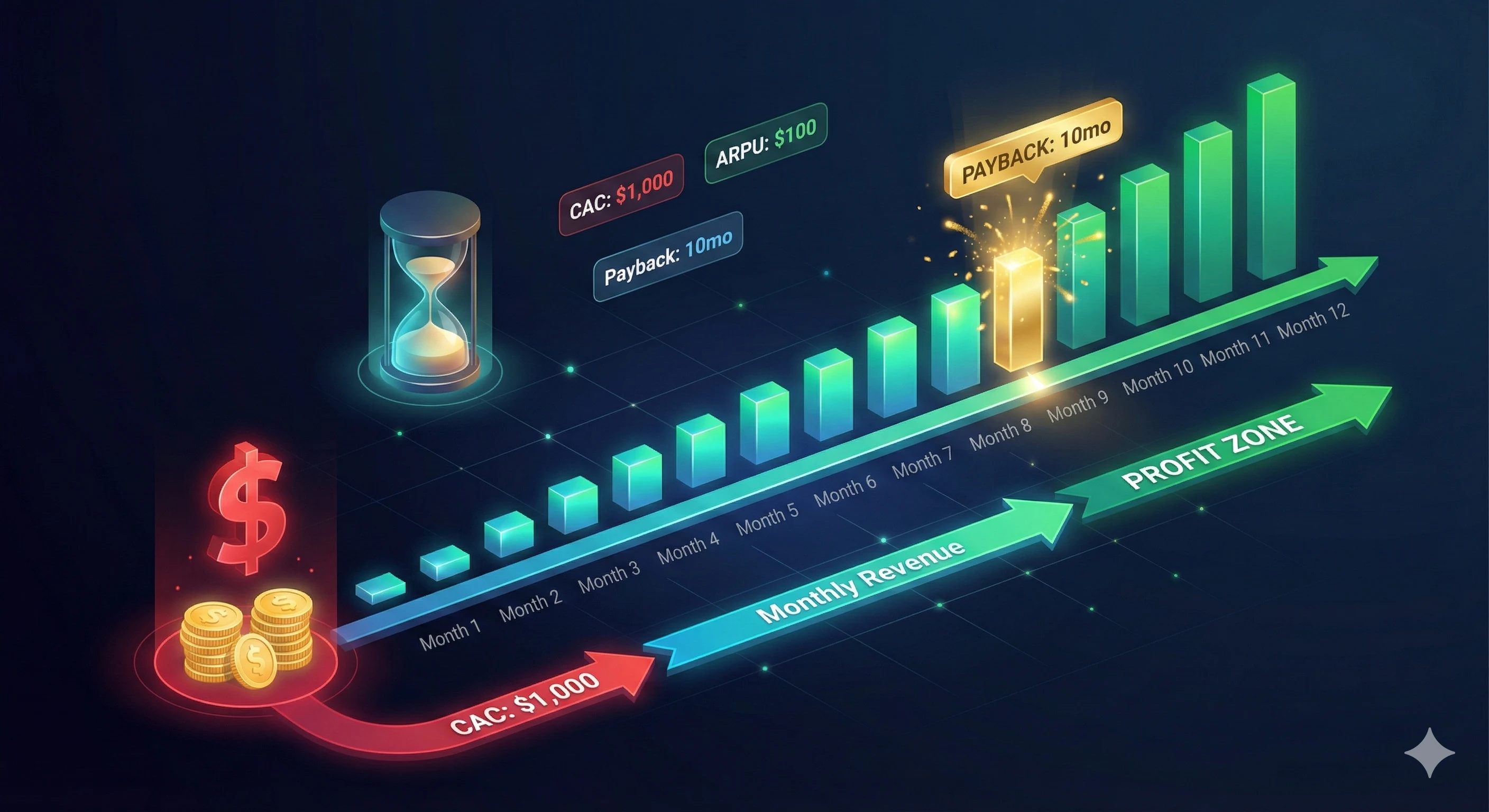
Payback Period: The Complete Guide for SaaS & Ecommerce (2026)
Payback period is the ultimate cash flow metric. It tells you how long it takes to recover the cost of acquiring a customer—and whether your business model actually works.
You can have great LTV:CAC ratios on paper, but if it takes 3 years to recover your acquisition costs, you'll run out of cash long before you see profits.
This comprehensive guide covers everything you need to master payback period analysis and optimize your unit economics.
Calculate Your Payback Period Now →
What is Payback Period?
Payback period is the time it takes to recover the cost of acquiring a customer through the gross profit they generate. It's typically measured in months.
The Simple Concept
You spend $100 to acquire a customer.
They pay you $25/month with 80% gross margin ($20/month gross profit).
Payback period = $100 / $20 = 5 months
After 5 months, you've recovered your acquisition cost. Everything after that is profit (until they churn).
Why Payback Period Matters More Than You Think
For Cash Flow:
- Short payback = faster capital recycling
- Long payback = need more funding to grow
- Determines sustainable growth rate
- Affects working capital requirements
For Investors:
- VCs want < 12 month payback
- Longer payback requires more capital to scale
- Key metric for Series A/B funding
- Proves unit economics viability
For Growth:
- Shorter payback = reinvest profits faster
- Enables compound growth
- Less reliance on external capital
- Faster path to profitability
CAC Payback Period Explained
CAC Payback Period specifically measures how long to recover Customer Acquisition Cost (not total customer cost).
What's Included in CAC
Marketing Costs:
- Paid advertising spend
- Content marketing
- SEO and website
- Marketing tools and software
- Creative production
- Agency fees
Sales Costs:
- Sales salaries and commissions
- Sales operations
- Sales tools (CRM, dialers)
- Sales training
- Demo costs
Divided by: Number of new customers acquired
What's Included in Gross Profit
Revenue: Monthly recurring revenue (MRR) or average order value (AOV)
Minus Cost of Goods Sold (COGS):
- Product/service delivery costs
- Hosting and infrastructure
- Transaction fees
- Support costs (sometimes)
- Direct labor
Gross Margin = (Revenue - COGS) / Revenue
Typical Gross Margins:
- SaaS: 70-90%
- Ecommerce: 30-60%
- Marketplace: 60-80%
- Services: 40-70%
How to Calculate Payback Period
The Standard Formula
Payback Period (months) = CAC / (ARPU × Gross Margin)
Where:
- CAC = Customer Acquisition Cost
- ARPU = Average Revenue Per User (monthly)
- Gross Margin = (Revenue - COGS) / Revenue
Step-by-Step Calculation
Example: SaaS Business
Step 1: Calculate CAC
- Q1 2026 marketing spend: $150,000
- Q1 2026 sales costs: $100,000
- Total acquisition costs: $250,000
- New customers acquired: 250
- CAC = $250,000 / 250 = $1,000
Step 2: Determine ARPU
- Average subscription price: $150/month
- ARPU = $150
Step 3: Calculate Gross Margin
- Monthly revenue per customer: $150
- Monthly COGS (hosting, support): $30
- Gross profit: $120
- Gross Margin = $120 / $150 = 80%
Step 4: Calculate Payback Period
Payback = $1,000 / ($150 × 0.80)
Payback = $1,000 / $120
Payback = 8.3 months
Interpretation: Takes 8.3 months of customer paying to recover acquisition cost.
Ecommerce Payback Calculation
Example: DTC Brand
Step 1: Calculate CAC
- Monthly ad spend: $100,000
- Monthly customers acquired: 500
- CAC = $200
Step 2: Determine AOV and Frequency
- Average order value: $75
- Purchase frequency: 3x per year (0.25x per month)
- Monthly revenue per customer = $75 × 0.25 = $18.75
Step 3: Calculate Gross Margin
- AOV: $75
- COGS per order: $30
- Gross profit per order: $45
- Gross margin = 60%
Step 4: Calculate Payback Period
Payback = $200 / ($18.75 × 0.60)
Payback = $200 / $11.25
Payback = 17.8 months
Interpretation: Takes nearly 18 months to recover acquisition cost (requires multiple purchases).
Simple vs. Discounted Payback Period
Simple Payback Period
What we've calculated above. Ignores time value of money.
Pros:
- Easy to calculate
- Easy to understand
- Good for short payback periods (<12 months)
Cons:
- Ignores cost of capital
- Doesn't account for inflation
- Less accurate for long payback periods
Discounted Payback Period
Accounts for time value of money by discounting future cash flows.
Discounted Payback Formula
Discounted Payback = CAC / (Monthly Gross Profit / (1 + r)^n)
Where:
- r = discount rate (typically 10-15% annually, or ~1% monthly)
- n = month number
Example:
- Simple payback: 12 months
- Discounted payback (10% annual discount): ~13 months
When to Use: For payback periods >18 months or when cost of capital is high
Most businesses use simple payback for day-to-day operations and benchmarking.
Industry Benchmarks by Business Type
B2B SaaS Benchmarks
By Customer Segment:
Enterprise ($100k+ ACV):
- Excellent: 12-18 months
- Good: 18-24 months
- Acceptable: 24-36 months
- Concerning: >36 months
Mid-Market ($10k-$100k ACV):
- Excellent: 6-12 months
- Good: 12-18 months
- Acceptable: 18-24 months
- Concerning: >24 months
SMB (<$10k ACV):
- Excellent: 3-6 months
- Good: 6-9 months
- Acceptable: 9-12 months
- Concerning: >12 months
Why Enterprise Can Have Longer Payback:
- Much higher LTV justifies longer payback
- Lower churn rates
- Higher gross margins
- Expansion revenue potential
B2C SaaS Benchmarks
Monthly Subscription:
- Excellent: 3-6 months
- Good: 6-9 months
- Acceptable: 9-12 months
- Concerning: >12 months
Annual Subscription:
- Excellent: 0-3 months (immediate payback from annual payment)
- Good: 3-6 months
- Acceptable: 6-12 months
- Concerning: >12 months
Ecommerce Benchmarks
DTC/Subscription:
- Excellent: 6-9 months
- Good: 9-12 months
- Acceptable: 12-18 months
- Concerning: >18 months
One-Time Purchase:
- Excellent: 3-6 months (2-3 purchases)
- Good: 6-12 months (3-5 purchases)
- Acceptable: 12-18 months
- Concerning: >18 months
High-Ticket Items ($500+):
- Excellent: 0-6 months (often immediate with first purchase)
- Good: 6-12 months
- Acceptable: 12-18 months
Marketplace Benchmarks
Two-Sided Marketplace:
- Excellent: 6-9 months
- Good: 9-12 months
- Acceptable: 12-18 months
- Concerning: >18 months
Network Effects: Payback often improves over time as marketplace density increases
What's a Good Payback Period?
The Golden Standard: 12 Months
12 months or less is the gold standard for most businesses.
Why 12 Months:
- Recover CAC within one year
- Sustainable growth without constant funding
- Can reinvest profits into more acquisition
- De-risked from churn (most churn happens early)
The Excellence Threshold: 6 Months
6 months or less is world-class.
What It Enables:
- Rapid compounding growth
- 2x capital recycling per year
- High margins on customer acquisition
- Aggressive scaling without external capital
Companies with <6 Month Payback:
- Zoom (pre-pandemic)
- Datadog
- Monday.com
- Shopify
The Concern Threshold: 18 Months
18+ months starts becoming problematic.
Why It's Concerning:
- Significant cash flow strain
- High risk if customers churn early
- Requires substantial capital to grow
- Less attractive to investors
- Long break-even timeline
When 18+ Months Can Work:
- Very high LTV (>$10k)
- Very low churn (<5% annual)
- Strong expansion revenue
- Access to cheap capital
Payback Period vs. ROI: Key Differences
Payback Period
What It Measures: Time to recover initial investment
Focus: Cash flow and timing
Example: 8 months to recover $1,000 CAC
Good For:
- Understanding cash flow needs
- Growth planning
- Capital requirements
- Short-term financial health
ROI (Return on Investment)
What It Measures: Total return on investment
Focus: Profitability over customer lifetime
Example: 3x return on $1,000 CAC = $3,000 total profit
Good For:
- Long-term profitability analysis
- Marketing channel comparison
- Strategic decision making
- Overall business health
Why You Need Both
Scenario:
- Option A: 6 month payback, 2x LTV:CAC (18 month lifetime)
- Option B: 18 month payback, 5x LTV:CAC (48 month lifetime)
Option A is better for:
- Cash flow management
- Rapid scaling
- Capital efficiency
- Risk management
Option B is better for:
- Long-term profitability
- Mature business
- Investor valuation
- Exit multiples
Most fast-growing businesses optimize for Option A (shorter payback) because cash flow enables growth.
Payback Period and Cash Flow Management
The Cash Flow Cycle
Month 0: Spend $1,000 to acquire customer Months 1-8: Collect $125/month in gross profit Month 8: Break even (recovered $1,000) Month 9+: Pure profit
The Problem: If you acquire 100 customers/month, you need $100k in capital every month for 8 months before seeing returns.
Total Capital Needed: $800k to sustain 8-month payback at 100 customers/month
Why Short Payback Matters for Growth
6 Month Payback Example:
- Start with $100k
- Month 0: Acquire 100 customers (spend $100k)
- Month 6: Recover $100k
- Month 6: Reinvest $100k into 100 more customers
- Month 12: Recover another $100k
- Result: 2x capital recycling per year
18 Month Payback Example:
- Start with $100k
- Month 0: Acquire 100 customers (spend $100k)
- Month 18: Recover $100k
- Month 18: Reinvest $100k
- Result: 0.67x capital recycling per year
Impact: 6-month payback grows 3x faster with same starting capital!
Managing Negative Cash Flow
Strategies for Long Payback:
- Annual Contracts: Get 12 months upfront, instant payback
- Graduated Growth: Grow slower until you hit break-even
- Raise Capital: Use VC funding to cover negative cash flow period
- Focus on High-Margin: Prioritize customers with faster payback
- Improve Gross Margin: Reduce COGS to speed payback
How Churn Affects Payback Period
The Critical Question
What if customers churn before you recover CAC?
Example:
- CAC: $1,000
- Payback period: 12 months
- Average customer lifetime: 9 months
- Result: You lose $250 on every customer!
The Payback-Churn Rule
Your payback period must be significantly shorter than your average customer lifetime.
Safe Ratios:
- Payback < 50% of customer lifetime: Safe
- Payback 50-75% of lifetime: Acceptable but risky
- Payback > 75% of lifetime: Extremely risky
- Payback > 100% of lifetime: Business doesn't work
Example Analysis
Scenario 1: Healthy
- Payback: 8 months
- Average lifetime: 24 months
- Ratio: 33% (safe)
- Net profit per customer: $2,000
Scenario 2: Risky
- Payback: 15 months
- Average lifetime: 18 months
- Ratio: 83% (risky)
- Net profit per customer: $375
Scenario 3: Broken
- Payback: 18 months
- Average lifetime: 12 months
- Ratio: 150% (broken)
- Net profit per customer: -$500
Action: If your ratio is >75%, either shorten payback or improve retention urgently.
Cohort-Based Payback Analysis
Not all customers have the same lifetime.
Track Payback by Cohort:
- Organic customers: 6 month payback, 36 month lifetime (healthy)
- Paid social customers: 12 month payback, 18 month lifetime (risky)
- Referral customers: 3 month payback, 48 month lifetime (excellent)
Action: Shift budget toward channels with best payback/lifetime ratios.
7 Proven Ways to Shorten Payback Period
Strategy 1: Annual Contracts and Upfront Payment
Impact: Immediate or near-immediate payback
How It Works:
- Monthly plan: $100/mo, 10 month payback
- Annual plan: $1,000 upfront (15% discount), 1 month payback
Tactics:
- Offer 10-20% discount for annual
- Make annual the default (most visible option)
- Include extra features for annual
- Lock in pricing (protect from future increases)
- Provide invoice/NET-30 for enterprise
Expected Impact: Reduces payback from 10-12 months to 0-3 months
Tradeoff: Lower monthly revenue but much better cash flow
Strategy 2: Improve Gross Margin
Impact: Faster payback with same revenue
Example:
- Current: $100 revenue, $40 COGS, 60% margin, 12 month payback
- Improved: $100 revenue, $25 COGS, 75% margin, 9.6 month payback
- 20% reduction in payback
Tactics to Improve Gross Margin:
SaaS:
- Optimize infrastructure costs (AWS savings, right-sizing)
- Automate support (reduce support cost per customer)
- Increase pricing (if market supports it)
- Reduce transaction fees (negotiate with Stripe, etc.)
Ecommerce:
- Negotiate better supplier pricing (volume discounts)
- Reduce shipping costs (better carrier rates)
- Decrease returns (improve product quality/descriptions)
- Optimize warehouse operations
- Private label products (cut out middleman)
Expected Impact: 15-30% reduction in payback period
Strategy 3: Reduce CAC
Impact: Direct reduction in payback period
Example:
- Current CAC: $500, 10 month payback
- Reduced CAC: $350, 7 month payback
- 30% reduction in payback
Tactics:
- Improve conversion rates (same spend, more customers)
- Optimize paid campaigns (lower CPC/CPM)
- Build organic channels (content, SEO, referrals)
- Improve landing pages (better conversion)
- Better targeting (less waste)
Calculate your CAC: CAC Calculator →
Expected Impact: 20-40% reduction in payback period
Strategy 4: Increase ARPU
Impact: Earn more per customer, faster payback
Example:
- Current ARPU: $50/mo, 12 month payback
- Increased ARPU: $75/mo, 8 month payback
- 33% reduction in payback
Tactics:
- Raise prices (simplest but test carefully)
- Add higher-priced tiers
- Create add-ons and premium features
- Bundle products/services
- Implement usage-based pricing
- Cross-sell complementary products
Expected Impact: 15-35% reduction in payback period
Strategy 5: Improve Early Retention
Impact: More customers reach payback period
Why It Matters: If 30% churn before payback, you're wasting 30% of your CAC.
Tactics:
- Better onboarding (time-to-value < 5 minutes)
- Proactive customer success (don't wait for problems)
- Engagement campaigns (keep them using your product)
- Quick wins in first 7 days
- Address churn reasons from exit surveys
Expected Impact: 10-25% effective reduction in payback (fewer lost customers)
Strategy 6: Usage-Based Pricing
Impact: Revenue grows with customer usage, faster payback
Example:
- Flat pricing: $100/mo forever, 10 month payback
- Usage-based: Start at $50/mo, grow to $150/mo, 6 month payback
Tactics:
- Charge per API call, transaction, user, etc.
- Start with low entry price, grow with usage
- Aligns pricing with value delivery
- Natural upsell path
Companies Using Usage-Based:
- Stripe (per transaction)
- AWS (per resource)
- Twilio (per message)
- Snowflake (per query)
Expected Impact: 20-40% reduction in payback period
Strategy 7: Focus on High-Value Customer Segments
Impact: Target customers with shorter payback
Analysis:
- Enterprise: $10k CAC, 18 month payback, but 5x LTV
- SMB: $500 CAC, 6 month payback, 3x LTV
- Both can be profitable, but SMB has better cash flow
Tactics:
- Analyze payback by customer segment
- Shift marketing spend to segments with shortest payback
- Create tiered acquisition strategies
- Use enterprise for valuation, SMB for growth
Expected Impact: 30-50% blended payback reduction
Real Examples from Different Business Types
Example 1: B2B SaaS (Mid-Market)
Company: Project management software
Metrics:
- CAC: $2,500
- ARPU: $500/month
- Gross margin: 85%
- Monthly gross profit: $425
- Payback period: 5.9 months
Actions Taken:
- Introduced annual plans (50% take rate) → 2 month payback for annual
- Increased ARPU from $500 to $600 with new features → 5 month payback
- Improved onboarding → 15% better first-year retention
Result: Blended payback improved from 5.9 to 4.2 months
Example 2: DTC Ecommerce (Subscription)
Company: Coffee subscription
Metrics:
- CAC: $45
- AOV: $35
- Gross margin: 55%
- Purchase frequency: 1.2x/month
- Monthly gross profit: $23.10
- Payback period: 1.9 months
Actions Taken:
- Created annual prepay plan (10% discount) → Immediate payback
- Improved retention from 6 to 9 months → Better lifetime coverage
- Launched add-ons (coffee accessories) → Increased basket by 15%
Result: Payback improved to 1.5 months, annual option has 0.5 month payback
Example 3: Marketplace Platform
Company: Freelancer marketplace
Metrics:
- CAC (per side): $80
- Transaction value: $200 average
- Take rate: 15%
- Revenue per transaction: $30
- Gross margin: 90%
- Transaction frequency: 2.5x/month
- Monthly gross profit per user: $67.50
- Payback period: 1.2 months
Actions Taken:
- Introduced subscription tier for freelancers (lower take rate but fixed fee) → More predictable revenue
- Improved matching algorithm → Higher transaction frequency
- Added value-added services (escrow, payment processing) → Higher effective take rate
Result: Payback improved to 0.9 months with subscription tier
Common Payback Period Calculation Mistakes
Mistake #1: Using Revenue Instead of Gross Profit
Wrong:
Payback = CAC / Monthly Revenue
Right:
Payback = CAC / (Monthly Revenue × Gross Margin)
Impact: Dramatically understates payback period
Example:
- Wrong calculation: 6 months
- Right calculation: 10 months (60% gross margin)
Mistake #2: Forgetting Full CAC
Wrong: Only including ad spend
Right: Include all sales and marketing costs (salaries, tools, agencies)
Impact: Understates true payback by 30-50%
Mistake #3: Not Accounting for Churn
Problem: Calculating payback but ignoring if customers stay long enough
Fix: Always compare payback to average customer lifetime
Critical: Payback should be < 50% of customer lifetime
Mistake #4: Ignoring Payment Terms
Problem: Calculating payback assuming immediate payment
Reality: B2B often has NET-30 or NET-60 payment terms
Fix: Add 1-2 months to payback period for payment delays
Mistake #5: Using Blended Metrics Without Segmentation
Problem: Averaging payback across all channels/segments
Reality: Different channels have wildly different payback
Example:
- Organic: 3 month payback
- Paid social: 15 month payback
- Blended: 9 month payback (looks okay)
Fix: Calculate payback by channel and optimize accordingly
Mistake #6: Not Including Onboarding Costs
Problem: Forgetting high-touch onboarding costs for enterprise
Fix: Include onboarding, implementation, training in CAC or COGS
Impact: Enterprise payback may be 20-30% longer than calculated
Mistake #7: Assuming Linear Revenue
Problem: Assuming customers pay same amount every month
Reality:
- Many customers upgrade (usage-based pricing)
- Some customers downgrade
- Expansion and contraction affect payback
Fix: Use cohort analysis to track actual revenue curves, not averages
Conclusion
Payback period is one of the most important metrics for understanding the cash flow and sustainability of your growth. Optimize for too long a payback, and you'll need constant fundraising. Get it under 12 months, and you can scale profitably with internal cash flow.
Key Takeaways:
- Target < 12 months: Gold standard for most businesses
- < 6 months is world-class: Enables rapid compounding growth
- Payback must be < 50% of customer lifetime: Or you risk losing money
- Use gross profit, not revenue: Revenue is vanity, profit is sanity
- Improve gross margin: Often the fastest path to better payback
- Annual contracts: Easiest way to improve cash flow
- Track by cohort: Different channels have different payback
- Consider both payback and ROI: Short payback + high ROI = winner
- Don't forget churn: Great payback doesn't help if customers churn first
- Continuous optimization: Small improvements compound dramatically
Ready to calculate your payback period?
Calculate Your Payback Period →
Know your payback. Optimize your cash flow. Scale sustainably.
Related Resources:
- CAC Calculator - Calculate customer acquisition cost
- Customer LTV Calculator - Calculate lifetime value
- Churn Rate Calculator - Track customer retention
- Break-Even Calculator - Understand profitability
Questions? Contact our finance team.
Share this insight
Help your network discover smarter analytics.